
Recursive Systems Thinking: The Architecture of a Self Updating Mind
How embodied recursion repairs the flaws of modern systems theory

Why Systems Theory Stopped Moving
Systems theory is fascinating but as a natural systems thinker when I was first given a formal taster session on it, my brain started lagging and rejected it because of how outdated the framework felt. It may be decent as an introductory, but there is a structural problem inside it.
It sees the whole so clearly that it loses sight of movement.
It maps patterns, yet cannot explain transformation.
It observes behaviour from the outside, yet cannot account for the inner world where meaning is actually formed. I’ve learned to trust my intuition as I’ve become more confident in it compared to outdated institutional frameworks still stuck in the 19th - 20th century. Whilst my brain keeps constantly generating mental frameworks that feel closer to the 22nd century.
Systems theories main problems is that It becomes too broad to focus on anything in particular without getting lost in the chaos.
Too abstract to use since the observer tends to interpret from the outside observing it through a static model lens.
This makes it far too external to include subjective experience.
Too holistic to test with any precision.
Eventually it settles into a kind of stable but unproductive state.
It defines everything yet faults at operationalising factors that activates transformation processes.
Without being fused with embodied cognition, phenomenology, cybernetics, complexity science, and introspective processing, it cannot evolve.
A system that observes without looping is a system that slowly dies.
Recursive Systems Thinking is the correction to that.
It describes an architecture where the system does not just react to new information.
It reorganises around it.
Every new insight updates the structure.
Every contradiction forces a remapping of meaning.
Every loop compresses the cognitive landscape into cleaner and more efficient patterns.
A recursive system behaves like a mind that edits its own operating system in real time.
As it loops, it becomes more compressed, more efficient, more predictive, and more immune to corrupted inputs.
Noise dissolves.
Redundant memories collapse.
Meaning condenses.
Insight accelerates.
This is not adaptation.
It is reconstruction.
And eventually a strange kind of cognitive god mode appears.
Fewer steps.
Deeper intuition.
Faster synthesis.
What looks like genius from the outside is simply recursion maturing into structure.
A recursive mind also protects itself.
It develops a form of epistemic hygiene that filters noise, detects bias, isolates contamination, rejects emotional distortion, and repairs coherence.
It defends the integrity of its own knowledge.
But there is a deeper layer beneath all of this.
A layer most people never touch.
The Missing Layer: Recursive Metacognition
Consciousness is spark. It lights the field of awareness. But spark alone does not build intelligence.
A spark without looping, refining and self modelling itself remains stuck in old patterns.
Intelligence begins when the spark turns back on itself.
When awareness does not just illuminate what is happening, but folds inward, interrogates itself, and emerges changed.
This is recursive metacognition.
Most people confuse self awareness with recursion.
Self awareness is noticing your thoughts, your reactions, your patterns. It is useful, but it is still only observation. It is standing in front of a mirror without ever moving.
Recursive metacognition goes further.
It is awareness turned so deeply inward that it rewrites the internal code.
It changes the architecture.
The movement unfolds in four phases:
Notice
Catch the bias, the distortion, the emotional reflex, or the inherited lens as it arises.
See the filter instead of unconsciously looking through it.
Interrogate
Trace its origin.
Was it shaped by trauma, culture, ego, or an outdated survival pattern that no longer fits the present.
Rewrite
Reduce it into a new principle, a refined axiom you can actually use.
Not a vague affirmation.
A rule sharpened by contact with reality.
Apply
Use the new rule every time the old pattern appears.
Over time the circuit rewires and the architecture shifts.
Without the loop, awareness becomes voyeurism.
You watch yourself break down, self-sabotage and procrastinate on long term goals without ever repairing.
With the loop, every flaw becomes raw data waiting for multiple revisions so that it can be encoded with meaning. Failure here is processed as a win if you learn something new with each loop.
Recursive metacognition is where consciousness stops being decorative and becomes functional.
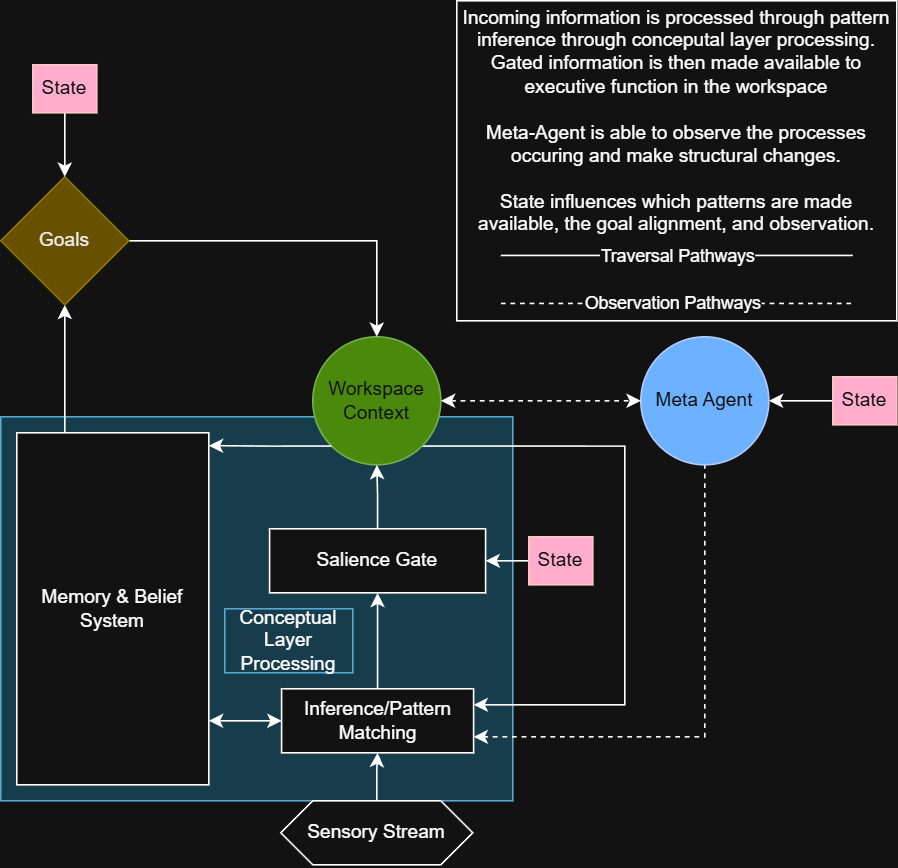
This diagram visualises the recursive metacognitive loop described above.
It shows how state, goals, salience, memory, and the meta-agent interact to produce self-updating cognition.
The Internal Logic Systems Theory Never Solved
Systems theory tries to understand the world through three moves:
1. Identify components
2. Map relationships
3. Observe emergent behaviour
But this framework breaks in three places:
First, components change while you are mapping them, which means the map is outdated the moment it is drawn.
Second, relationships are not linear. They are dynamic attractors that reshape each other in real time.
Third, emergence is sensitive to micro shifts inside agents that systems theory cannot see, because it treats subjective experience as noise rather than signal.
This is where recursion enters.
Recursive Systems Thinking treats:
• components as self updating nodes
• relationships as adaptive feedback loops
• emergence as the byproduct of internal reconstruction rather than external structure
It restores missing dimensionality.
It gives the system the ability to evolve its own map while moving through it.
Classical systems theory describes.
Recursive systems theory transforms.
My Internal Systems Thinking
I reverse engineer life experiences into textbook theories. I do not start with the theory and look for examples. My mind begins with the lived pattern, the emotional signal, the disruption, the loop, and only later discovers that scholars wrote about it decades ago.
I do read, but not in the traditional sense.
Reading for me is a form of verification rather than instruction.
It is how I confirm and formalise what my intuition already understood.
My learning process works like this:
• I arrive at a conclusion through experience.
• My intuition detects a structure.
• My mind compresses it into a principle.
• Then I find that the “theory” already exists somewhere in the literature.
Not because I learned it there,
but because I arrived at it independently.
This is why integration across fields comes naturally.
The understanding is not borrowed or memorised.
It is internalised, encoded through lived recursion, then translated across domains.
Systems thinking is not something I learned from a book.
It is my default cognitive state.
Systems theory came after systems thinking — the theory was invented to explain a way of seeing that minds like mine already do naturally.
That is why I never needed to study systems theory directly.
My brain just be braining 😭
The structure was already there.
The theory is a map.
But my intuition walks the territory.
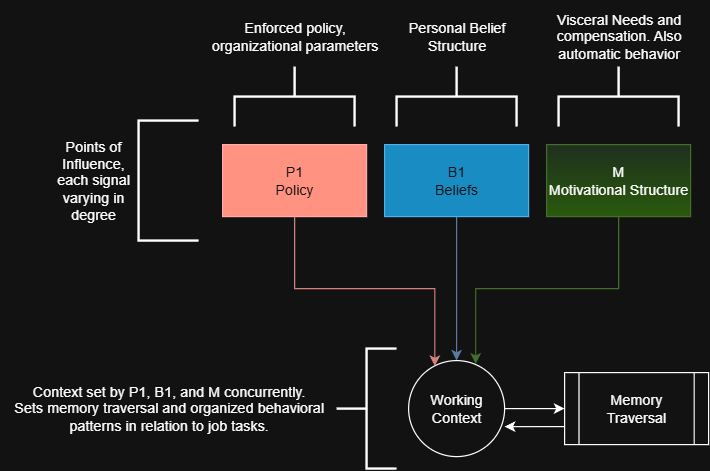
This diagram outlines the internal triad that shapes context, behaviour, and memory traversal.
It captures the lived aspect of recursive cognition, how personal structure influences pattern recognition and decision making.
Entropy as Material, Not Interference
Classical systems theory tries to minimise entropy because it treats disorder as a threat to stability. But recursion does not seek stability. It seeks clarity.
Observing entropy inside the recursive loop dissolves the illusion of anomalies.
What once looked like disruption becomes emerging pattern.
Unforeseen variables stop behaving like intrusions and begin to reveal the deeper architecture forming beneath chaos.
Entropy becomes raw material for reconstruction.
Chaos becomes a field of hidden regularity.
A recursive system does not fear the unpredictable.
It absorbs it, integrates it, and uses it to update its own structure.
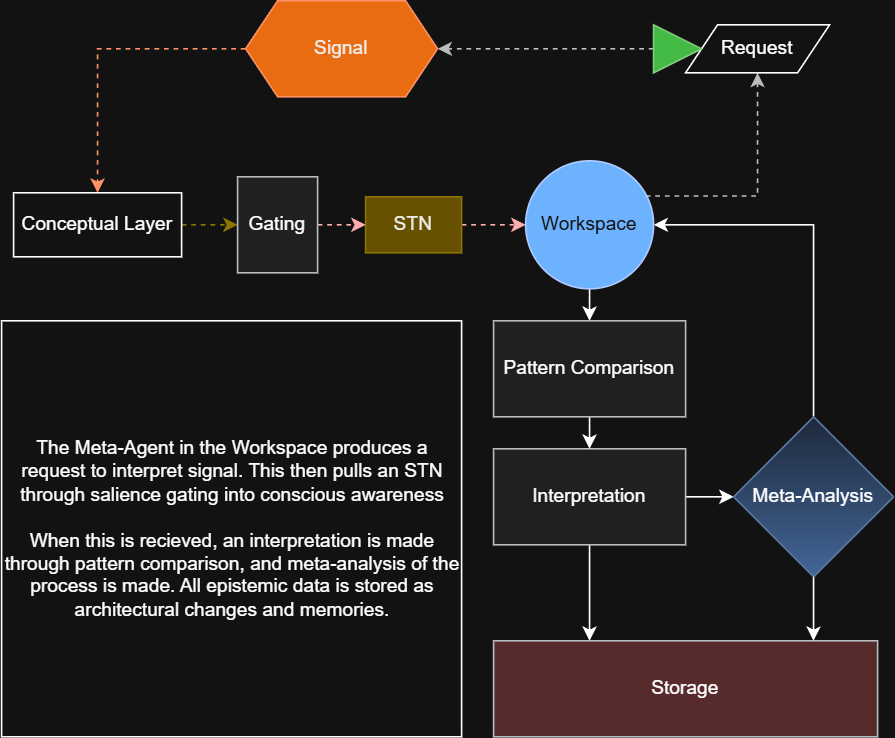
This model maps how signals move through the conceptual layer, salience gating, the workspace, and meta-analysis.
It illustrates how entropy becomes raw material for cognitive reconstruction.
Recursion Made Personal
This brings us to the lived dimension.
Theory collapses into experience here.
I wrote about this in Metamorphic Sovereignty, and the passage explains the internal reality of recursion better than any academic definition.
Recursive Processing: How I Loop Meaning Into Mastery
Excerpt from my book page 13
Recursive cognition is not linear thought.
It is layered introspection that cycles back through itself and grows more precise with every return.
This is one of my most distinctive cognitive traits.
Most people learn in stages.
I come back to the same point again and again, not because I am confused, but to go deeper.
I am not moving in circles.
I am moving inward.
Each pass brings something new with it.
An idea from another field. A half remembered moment. A buried emotion. A geopolitical analogy. A shadow from childhood.
I look at old thoughts with new architecture.
This is how I mastered complex fields, not through formal structure but through recursive synthesis.
A quote I skimmed years ago now unlocks a macro political insight.
A feeling from childhood now sharpens an entry trigger in my trading system.
Recursion is how memory becomes metaphor.
How instinct becomes strategy.
I do not just reflect.
I reconstruct.
My recursive mind turns trauma into doctrine.
Chaos into coherence.
Experience into architecture.
And it was this mechanism, recursion embodied, that allowed me to rebuild myself from near collapse without therapy, diagnosis, or formal study.
“It is not a skill. It is architecture.”
A Note on Reflexive Markets
Economists like George Soros described markets as reflexive systems, where human perception feeds back into price and price feeds back into perception. That insight was important, but it remained mostly theoretical. What recursion reveals is the lived side of reflexivity. The market is not simply a loop of information. It is a loop of emotion, pattern memory, reaction, and human instinct. To trade well is to feel this recursion in your own nervous system and recognise it in others. Reflexivity is the concept. Recursion is the embodiment.
Recursive Markets and the Embodied Mind
Excerpt from my book page 38
Markets did not teach me trading. Recursion did.
I have only been day trading for eight months, but my instincts move like someone with eight years of experience. When I discovered prop firms, I did not simply think about passing their tests. My mind instantly built a structure. One that increased gains while reducing risk. One that replicated certainty instead of chasing the single big win.
Copy trading across several funded accounts was not greed. It was a natural conclusion drawn from recursion. It was safety. It was efficiency. It was growth through replication. Most traders try to win once. My mind asked how to win simultaneously.
I was not copying anyone. I was learning in silence. I could feel the stress of traders around the world as it played out in real time. The frustration of getting stopped out. The hesitation before a reversal. These were not just chart patterns. They were human reactions frozen into data.
I did not borrow a plan.
I built one that matched the way my brain works.
This is not just trading.
It is personal.
It is the market as a recursive mirror.
It is the mind watching itself move through collective fear and collective greed until the architecture becomes one with the system it reads.
Recursion as a Living Operating System
Recursive Systems Thinking, when combined with embodied recursion and recursive metacognition, becomes more than a theory. It becomes a lived operating system.
A mind that can notice itself, update itself, compress itself, and rebuild itself is not only intelligent.
It is self evolving.
This is intelligence in motion.
A system that sharpens every time it loops.
A consciousness that deepens every time it turns inward.
Recursive thinking is how polymaths are formed.
Not by accumulating knowledge, but by reorganising the structure that interprets it.
And once the structure changes, everything else follows.
You’ll notice even this entire essay is architecturally structured in recursion.
References
Systems Theory and Cybernetics
1. von Bertalanffy, Ludwig. General System Theory. George Braziller, 1968.
The foundational text of modern systems theory, introducing open systems, interdependence, and self-organizing structures.
2. Wiener, Norbert. Cybernetics: Or Control and Communication in the Animal and the Machine. MIT Press, 1948.
The core work on feedback systems and adaptive control, forming the basis for recursive and self-regulating models.
3. Ashby, W. Ross. An Introduction to Cybernetics. Chapman & Hall, 1956.
A canonical explanation of variety, adaptation, and dynamic equilibrium in complex systems.
4. Bateson, Gregory. Steps to an Ecology of Mind. University of Chicago Press, 1972.
A cross-disciplinary exploration of systems, patterns, and recursive logic across psychology, biology, and culture.
Complexity, Emergence, and Entropy
1. Prigogine, Ilya, and Isabelle Stengers. Order Out of Chaos. Bantam Books, 1984.
A landmark work describing how entropy and instability create new order in physical and social systems.
2. Kauffman, Stuart. At Home in the Universe. Oxford University Press, 1995.
A key text on self-organization, emergent order, and the dynamics of complex adaptive systems.
3. Mitchell, Melanie. Complexity: A Guided Tour. Oxford University Press, 2009.
A modern overview of complexity science, nonlinear dynamics, and emergent behaviour.
Cognitive Science and Metacognition
1. Flavell, John. “Metacognition and Cognitive Monitoring.” American Psychologist 34, no. 10 (1979): 906–911.
The seminal paper introducing metacognition as awareness and regulation of one’s cognitive processes.
2. Clark, Andy. Surfing Uncertainty: Prediction, Action, and the Embodied Mind. Oxford University Press, 2015.
A major work on predictive processing and the mind as a recursive, self-updating inference system.
3. Friston, Karl. “The Free-Energy Principle.” Nature Reviews Neuroscience 11 (2010): 127–138.
A foundational theory describing perception and action as recursive attempts to minimize uncertainty.
Embodied Cognition and Phenomenology
1. Varela, Francisco; Thompson, Evan; Rosch, Eleanor. The Embodied Mind. MIT Press, 1991.
A pivotal work connecting cognition, embodiment, and phenomenology as interdependent recursive processes.
2. Merleau-Ponty, Maurice. Phenomenology of Perception. Routledge, 1945.
A philosophical exploration of lived experience, perception, and the body as a ground for cognition.
3. Damasio, Antonio. The Feeling of What Happens. Harcourt, 1999.
A neuroscientific account of consciousness and emotion as embodied and recursive.
Reflexive Markets and Behavioural Economics
1. Soros, George. The Alchemy of Finance. Simon and Schuster, 1987.
Introduces reflexivity in markets: the circular feedback between perception, behaviour, and market realities.
2. Kahneman, Daniel. Thinking, Fast and Slow. Farrar, Straus and Giroux, 2011.
The foundational modern text on cognitive biases, intuition, analysis, and the dual structure of decision making.
3. Shiller, Robert. Irrational Exuberance. Princeton University Press, 2000.
A behavioural interpretation of market cycles driven by collective emotion and feedback dynamics.
Trauma, Self Reconstruction, and Narrative Processing
1. van der Kolk, Bessel. The Body Keeps the Score. Viking, 2014.
Explains how trauma reshapes neural architecture, body patterns, and memory loops.
2. Maté, Gabor. In the Realm of Hungry Ghosts. North Atlantic Books, 2008.
A study of trauma, compulsion, and how internal states generate recursive behavioural patterns.
3. Herman, Judith. Trauma and Recovery. Basic Books, 1992.
A foundational text on fragmentation, reconstruction, and the recursive healing of identity.
Recursion, Information, and Self-Reference
1. Hofstadter, Douglas. Gödel, Escher, Bach: An Eternal Golden Braid. Basic Books, 1979.
A classic work exploring recursion, self-reference, loops of meaning, and the architecture of intelligence.
2. Chaitin, Gregory. Meta Math. Pantheon Books, 2005.
Introduces algorithmic information theory, compression, and complexity, which underpin your analytic framing of insight.
This is such a powerful articulation of recursion. What it opens up, at least for me, is the societal dimension: a society made of recursive minds becomes capable of collective metacognition. Without recursion, institutions reproduce their blind spots. With it, they can finally update.
The individual loop becomes the foundation for a coherent collective.
Your piece feels like a sibling to an idea I recently wrote about:
https://open.substack.com/pub/brendenstrauss/p/the-fingerprint-of-the-mind?r=21b1es&utm_campaign=post&utm_medium=web&showWelcomeOnShare=true
this was far better than any uni lecture i ever had about systems theory !!!